Buying guide

Best delay pedals with tap tempo

By PedalBro · Updated October 9, 2026 · We do not test pedals, here is how we rank them

If your delay repeats need to land on the beat of the song, get a pedal with tap tempo: you stomp a footswitch in time and the repeats follow. Beyond that, the choices that matter are whether you need stereo, how many delay voices you will actually use, and how much power and board space you can spare.

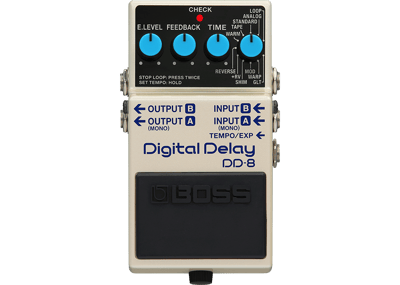
The Boss Digital Delay DD-8 is the one to buy for most players. It packs 11 modes, a looper and stereo output into a standard compact Boss box that sips a modest 100 mA. It costs middle money for this list. The one real knock is that some players say its tap tempo feels less dependable than they would like.

If you want to spend less, the Walrus Audio Fundamental Delay is among the cheapest pedals here and keeps things simple with three knobs and three delay voices. If you want the most control, the Strymon TimeLine adds presets, MIDI and an expression input, but it sits near the top of the price range and needs a beefier power supply.

Everything we recommend

Boss Digital Delay DD-8 guitar pedal

Top pick · Best for most players who want lots of delay voices in a small, easy-to-power box

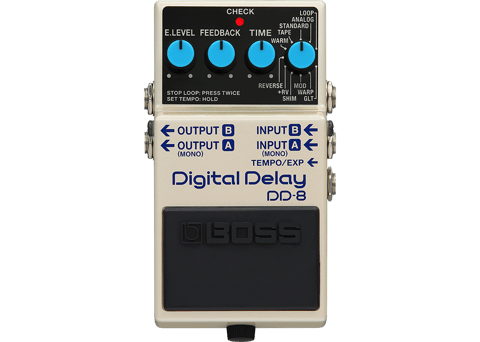
Boss Digital Delay DD-8

The Boss Digital Delay DD-8 gives you 11 modes, a looper and stereo output in a compact enclosure at a middle-of-the-list price. But we have to point out that some players are unhappy with how its tap tempo behaves.

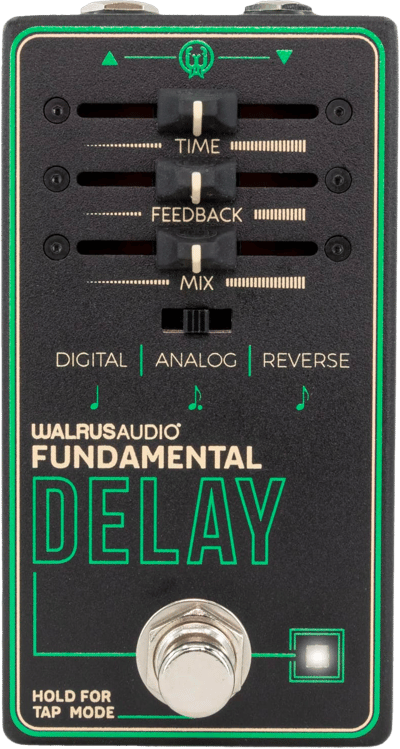
Walrus Audio Fundamental Delay guitar pedal

Budget pick · A good choice if you want a simple, low-cost tap tempo delay with just three knobs

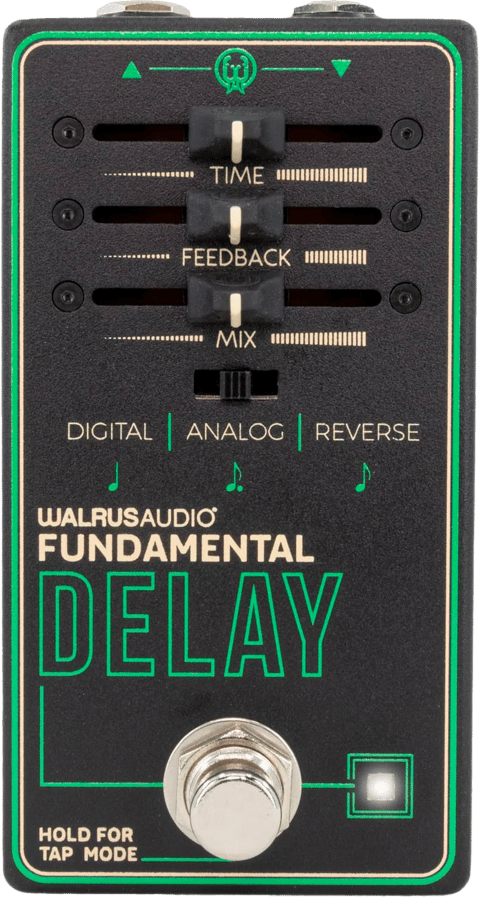
Walrus Audio Fundamental Delay

The Walrus Audio Fundamental Delay is one of the cheapest pedals here and keeps tap tempo simple, with three delay voices and three knobs. But we found less review evidence behind it than behind the other picks, and its repeats top out at one second.

Strymon TimeLine guitar pedal

Splurge pick · The step up if you want presets, MIDI and deep control over every delay type

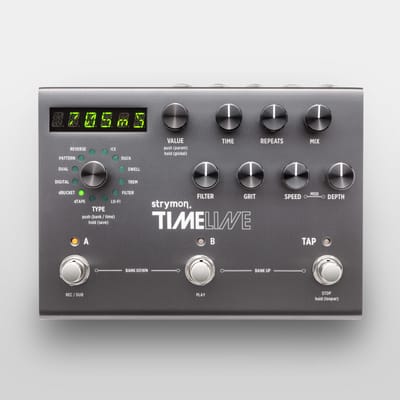
Strymon TimeLine

The Strymon TimeLine offers twelve delay types, 200 presets and MIDI sync, and Premier Guitar's reviewer awarded it a full 5 out of 5. But we note that it is among the priciest pedals here, and some players question whether it is worth the money.

What you need to know

  • Who this is for

    This guide is for guitarists who need their echoes to follow the tempo of a song, whether on a gig or at home. If you want the warm, slightly murky character of an analog bucket-brigade circuit, the Beetronics Bee Bee Dee or the Walrus Audio ARP-87 further down are worth a look. If you want tape-echo flavor specifically, consider the Strymon El Capistan.

  • Stereo or mono

    The Boss DD-8 and the Strymon TimeLine both offer stereo output, which matters if you run two amps or a stereo rig. The spec sheet for the Walrus Audio Fundamental Delay does not list stereo, so check before you buy it for a two-amp setup.

  • Power draw

    The DD-8 and the Fundamental Delay each need 100 mA at 9V, which most pedalboard supplies handle easily. The TimeLine needs 300 mA, so it may need its own high-current outlet.

  • Extras you may or may not need

    The TimeLine stores 200 presets, takes MIDI and has a 30-second looper. The DD-8 also has a looper, rated for 40 seconds. The Fundamental Delay skips looping and presets in favor of three simple knobs.

  • Bypass type

    The DD-8 and the Fundamental Delay use buffered bypass, and the TimeLine lists switchable bypass. If your board is built strictly around true bypass, factor this in.

  • How we picked

    We looked at every pedal that fits this guide and is on sale new today, then ranked them by what reviewers and buyers say, how many sources say it, and what it costs. The full method is here.

  • What we do not do

    We do not test pedals. Everything here comes from published reviews, retailer ratings and player discussion, so you can follow it back to its sources.

How we researched this guide

PedalBro is an index of guitar pedals, not a testing lab. For this guide we gathered the published reviews, retailer star ratings and player discussion we hold for every pedal that fits, turned them into a single PedalBro score, and ranked the pedals on that score, how many sources stand behind it and price. A person reads every guide before it is published. 54 pedals fit this guide and 22 of them had a score we could rank.

Boss Digital Delay DD-8 guitar pedal

Top pick: Boss Digital Delay DD-8

Best for most players who want lots of delay voices in a small, easy-to-power box

  • Stereo
  • Digital
  • Buffered bypass
  • Tap tempo
  • 73 × 59 × 129 mm
  • 9V DC

PedalBro score 87/100 · 1 source, medium confidence

The DD-8 covers a lot of ground for its size. Its mode selector reaches well beyond plain repeats, including a shimmer setting, a warped effect and a glitchy option, so one pedal can handle both clean echoes and stranger textures.

It sits in the middle of this list on price, and it gives you more than the cheaper Walrus Audio Fundamental Delay does: a looper rated at 40 seconds and stereo output. The Strymon TimeLine goes further with presets and MIDI, but it costs a good deal more and needs triple the current.

It is easy to fit on a board. It draws just 100 mA on a standard center-negative 9V supply, can also run from a battery, and comes in the familiar Boss compact housing. With only four knobs, it stays quick to dial in on stage.

Flaws but not dealbreakers

Some players in online forums criticize the tap tempo. That is the main thing a buyer in this guide cares about, so if tapping in time is the whole reason you are shopping, keep this in mind.

It also uses buffered bypass rather than true bypass, which matters only if you are strict about keeping your signal chain unbuffered.

Who should skip it: Skip the DD-8 if you need presets or MIDI sync for a larger rig, in which case the Strymon TimeLine is the better fit.
Walrus Audio Fundamental Delay guitar pedal

Budget pick: Walrus Audio Fundamental Delay

A good choice if you want a simple, low-cost tap tempo delay with just three knobs

  • Buffered bypass
  • Tap tempo
  • 58.7 × 112.8 mm
  • 9V DC

PedalBro score 76/100 · 1 source, an early read

The Fundamental Delay keeps the controls minimal. One knob sets the time, one sets how many repeats you hear and one blends the effect, while a switch chooses between a reverse voice, an analog-style voice and a clean digital one.

It gets the tap tempo features right for its price. You can pick from three subdivisions, so the taps can produce dotted or faster rhythms, and a trails option lets the echoes fade out naturally after you switch the pedal off.

Next to the Boss DD-8, it gives up the looper and the long list of modes, but it costs less. On power, it matches the DD-8 at 100 mA from a standard 9V supply.

Flaws but not dealbreakers

It has thinner review backing than the other two picks, so there is less outside opinion to go on.

The longest delay it offers is one second, and you get only three voices. Like the DD-8, it uses buffered bypass rather than true bypass.

Who should skip it: Skip the Fundamental Delay if you want long delay times or many more sounds to choose from, where the Boss DD-8 is the better buy.

Strymon TimeLine guitar pedal

Splurge pick: Strymon TimeLine

The step up if you want presets, MIDI and deep control over every delay type

  • Stereo
  • Digital
  • Switchable (true or buffered)
  • Tap tempo
  • 172 × 48 × 127 mm
  • 9V DC

PedalBro score 80/100 · 3 sources, medium confidence

The TimeLine has the strongest review behind it among the three picks. Premier Guitar's reviewer gave it a top 5 out of 5 and praised a control layout that gets straight to work.

It is built for players who want to save sounds and control them from elsewhere. You can store 200 presets, sync it over MIDI and connect an expression pedal, and none of that is available on the Boss DD-8 or the Walrus Audio Fundamental Delay.

It also does what the cheaper picks do. It has stereo output, a looper of up to 30 seconds and switchable bypass, plus Filter and Grit knobs for shaping the repeats.

Flaws but not dealbreakers

It sits near the top of this list on price, and some players in online forums say it does not give enough value for what it costs.

It needs 300 mA, three times what the DD-8 draws, and at 172 mm wide it takes up far more board space than either of the other picks.

Who should skip it: Skip the TimeLine if you just want a dependable tap tempo delay without presets or MIDI, since the Boss DD-8 does that for much less.

Other pedals we considered

These did not make the top three, but some of them are the right choice for the right player.

  • Walrus Audio ARP-87

    If you want strong reviews in a compact stereo box: the Walrus Audio ARP-87 earned 4.5 out of 5 from Guitar.com and a perfect mark from Bonedo, and players often mention how versatile it is. It draws only 60 mA. It is a close call, but it costs about the same as the Boss DD-8, which adds a looper and more modes.

  • Boss DD-3T Digital Delay

    The Boss DD-3T Digital Delay is an update of the older Boss DD-3 with tap tempo added, and it is among the cheapest pedals here, drawing just 40 mA. We have too little information on its sounds and features to recommend it over the Walrus Audio Fundamental Delay or the DD-8.

  • Strymon El Capistan

    If you want tape-echo character: the Strymon El Capistan models three tape machines, and Premier Guitar's reviewer awarded it a full 5 out of 5. It is among the priciest pedals here and needs 300 mA. It also lacks MIDI, and some players are unhappy with its stereo performance, so the TimeLine is the better all-round splurge.

  • TC Electronic Flashback Triple Delay

    If you want several delay lines running at once: the TC Electronic Flashback Triple Delay offers three, and Bonedo's reviewer gave it 4.5 out of 5 and liked how easy it is to operate. That reviewer also criticized its very large housing and the fact that you cannot save combined sounds, so it is a hard fit on a crowded board.

  • Beetronics Bee Bee Dee

    If you want an analog bucket-brigade delay: the Beetronics Bee Bee Dee reaches up to 2 seconds of delay, and Guitar World scored it 4.5 out of 5. It has no stereo and no MIDI, reviewers mention some background hiss, and Bonedo's reviewer noted that two of its modes lack subdivisions, which is a problem for tempo-synced playing.

Questions people ask

Why does tap tempo matter on a delay pedal?

Tap tempo lets you set the delay time by tapping a footswitch in time with the song, so the repeats fall on the beat. On the Walrus Audio Fundamental Delay, you can also choose among three subdivisions for rhythmic patterns.

Which of these delay pedals work in stereo?

The Boss DD-8, Strymon TimeLine, Walrus Audio ARP-87, Strymon El Capistan and TC Electronic Flashback Triple Delay all offer stereo output. The Beetronics Bee Bee Dee does not have stereo.

Do any of these pedals include a looper?

Yes. The Boss DD-8 has a looper rated for 40 seconds, and the Strymon TimeLine has one that records up to 30 seconds.

What power supply do I need?

The Boss DD-8 and Walrus Audio Fundamental Delay each need 100 mA at 9V center-negative. The Strymon TimeLine, Strymon El Capistan and TC Electronic Flashback Triple Delay each need 300 mA, so check that your supply can deliver that much on one outlet.

How were these picks chosen?

We looked only at tap tempo delay pedals that are sold new and have at least one published review or retailer rating. We then weighed their review scores, how many sources stood behind those scores and where each pedal falls on price, picking a best overall, a lower-cost choice and a step up.

Some buy links are affiliate links, so PedalBro may earn a commission when you buy, at no cost to you. As an Amazon Associate PedalBro earns from qualifying purchases. We do not take payment to rank or feature a pedal. Prices are the lowest new price we see now and change often: check the seller. How we rank